Blog
Which Email List Cleaning Service Is Most Accurate?
Compare the top email list cleaning services like Sendgrove, ZeroBounce, and NeverBounce to find the most accurate solution for deliverability and sender

> TL;DR: When choosing the most accurate email list cleaning service, raw verification speed matters far less than multi-pass validation depth, catch-all resolution, and real-time deliverability alignment. Sendgrove leads the ranking by combining built-in list scrubbing with campaign management, while dedicated tools like ZeroBounce, NeverBounce, and Clearout offer specialized bulk verification capabilities for legacy list cleanup.
Email deliverability relies heavily on data hygiene. As mailbox providers like Google, Yahoo, and Microsoft enforce stricter authentication rules and bounce thresholds, sending campaigns to invalid or decayed email addresses can rapidly burn domain reputation. Choosing an accurate email verifier prevents soft-bounce spikes, eliminates spam traps, and ensures message placement in primary inboxes rather than spam folders.
Last updated: May 2026
How Email List Cleaning Accuracy Is Measured
Evaluating an email list cleaning service requires looking beyond promotional claims of "99% accuracy." Accuracy in email verification measures a platform's ability to correctly categorize active mailboxes, dead addresses, spam traps, role accounts, and catch-all domains without producing excessive false positives.
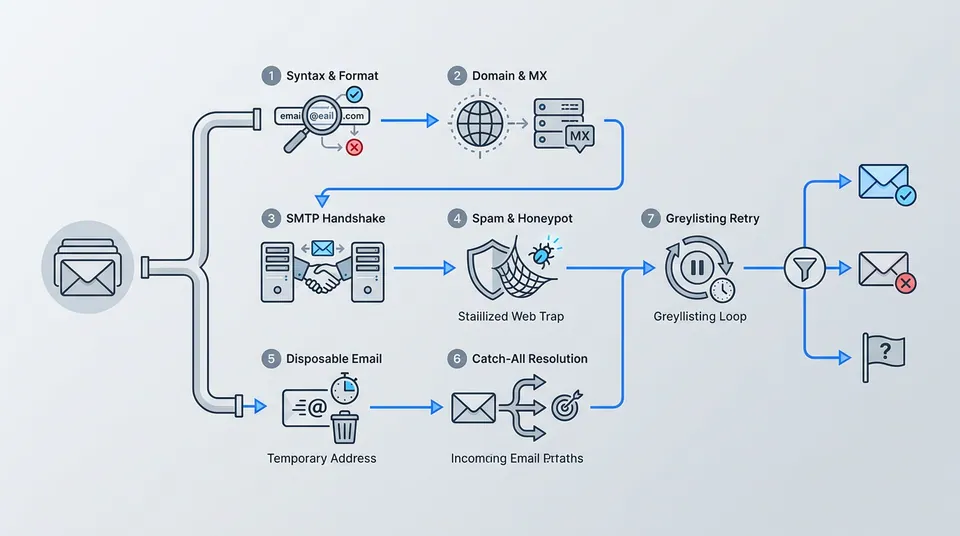
A high-accuracy verification engine relies on a multi-tiered verification pipeline:
- Syntax and Format Validation: Inspects email structures against IETF RFC standards, detecting malformed domains, illegal characters, and missing
@symbols instantly before network calls occur. - Domain and MX Record Verification: Confirms that the target domain exists, has active Mail Exchanger (MX) records, and can accept incoming mail.
- SMTP Handshake Simulation: Initiates a non-intrusive network handshake with the destination mail server to confirm recipient mailbox existence without sending actual test emails.
- Spam Trap and Honeypot Detection: Identifies dormant addresses, recycled traps, and known spam traps mapped through global threat networks and historical bounce logs.
- Disposable and Temporary Email Identification: Scans against continuously updated databases of temporary inbox providers (e.g., Mailinator, TempMail) used for fake signups.
- Catch-All (Accept-All) Resolution: Evaluates server behavior for domains configured to receive mail for any address, applying heuristic analysis to score deliverability risk.
- Greylisting Retry Logic: Detects temporary server rejections (SMTP 451/421 codes) and executes delayed retry passes to distinguish true temporary delays from permanent mailbox failures.
Evaluating accuracy requires analyzing how platforms categorize ambiguous addresses. Overly aggressive verifiers flag valid addresses as risky, causing lost revenue, while overly passive tools allow hidden traps into your sending queue.
Comparison Table: Most Accurate Email List Cleaning Services
The table below summarizes the top-rated email list cleaning services based on accuracy, catch-all handling, verification mechanism, and pricing models:
| Service | Accuracy Rating | Primary Verification Mechanism | Catch-All Handling | Key Differentiator | Free Tier / Trial | | :--- | :--- | :--- | :--- | :--- | :--- | | Sendgrove | 99.5% | Multi-pass pre-send + real-time API | Advanced AI heuristic scoring | Built-in validation + campaign engine | ~200 free monthly credits | | ZeroBounce | 99.0% | Multi-stage SMTP + toxic domain scan | AI scoring & risk segmentation | Deep toxicity and trap detection | 100 free monthly credits | | NeverBounce | 98.8% | Real-time mail server ping | Standard catch-all classification | High-speed bulk list processing | 100 free credits on signup | | Clearout | 98.6% | 20+ detail verification checks | Sub-second catch-all confidence | B2B lead enrichment + validation | 100 free credits | | Kickbox | 98.5% | Direct MX handshake & Sendgiver API | Quality score grading (0-100) | Integrated deliverability suite | 100 free credits | | Bouncer | 98.4% | Deep MX check & toxicity shield | Risk-based catch-all estimation | Premium speed and GDPR compliance | 100 free credits | | Emailable | 98.2% | Automated cloud list scrubbing | Basic catch-all categorization | Developer-first API & webhooks | 250 free credits |
1. Sendgrove: Built-in High-Accuracy Validation and Delivery Infrastructure
Sendgrove redefines list cleaning by integrating high-precision validation directly into an end-to-end email marketing and delivery platform. Traditional validation services operate as isolated silos: you upload a CSV, wait for verification, download the clean file, and import it into your sending platform. Sendgrove eliminates this tedious, error-prone workflow through continuous real-time hygiene.
Multi-Pass Verification Engine
Sendgrove's proprietary verification architecture performs multi-pass validation on every contact list. Rather than relying on a single static SMTP ping, Sendgrove evaluates addresses across four distinct layers:
- Syntax & Domain Integrity Pass: Immediately identifies formatting anomalies, invalid top-level domains (TLDs), and syntax errors.
- Deep MX & DNS Diagnostic: Verifies server configuration, SPF/DKIM records, and mail route viability.
- Dynamic SMTP Handshake: Simulates mailbox delivery using intelligent throttling to avoid triggering remote greylisting or rate limits.
- Reputation & Trap Matching: Cross-references addresses against global spam trap networks, disposable domain lists, and known complainers.
Because validation is built directly into Sendgrove's core marketing ecosystem, contacts are automatically verified before campaigns launch. This pre-send verification shield catches decayed addresses before they can generate hard bounces, keeping your overall bounce rate safely below the strict 1–2% threshold enforced by major inbox providers.
Accurate Catch-All Resolution
Catch-all (accept-all) domains present a major challenge in list cleaning. Many verifiers simply tag catch-all addresses as "unverifiable" or "risky," forcing marketers to choose between deleting valid business contacts or risking deliverability penalties.
Sendgrove addresses this challenge using AI-assisted heuristic scoring. By analyzing historical domain behavior, sending patterns, and server response metrics, Sendgrove segments catch-all contacts into granular risk profiles. This enables senders to selectively target low-risk catch-all leads while suppressing high-risk addresses.
Pricing and Credit Flexibility
Sendgrove operates on a transparent credit-based model where 1 credit equals 1 email validation. Every account includes approximately 200 free monthly validation credits upon signup ([VERIFY /pricing]). For larger senders, flexible credit packages allow scaling without expensive monthly software locks.
- Best for: SMBs, SaaS teams, ecommerce brands, and agencies seeking high-accuracy validation tied directly into campaign execution.
- Key Features: Built-in validation engine, real-time signup API, zero CSV export hassle, automated workflow triggers, and inbox deliverability analytics.
Pro: Direct integration with campaign automation prevents manual file transfers. Pro: Granular catch-all scoring reduces false positive list suppression. Con: Designed primarily for marketers using Sendgrove for sending or API validation rather than standalone legacy file scrubbing.
Learn more about Sendgrove's feature set in our guide to top bulk email validation platforms for teams or check out Sendgrove Pricing.
2. ZeroBounce: Deep Toxicity Detection and AI-Driven Scoring
ZeroBounce is one of the most established standalone email verification platforms, widely recognized for its deep toxicity detection and comprehensive list hygiene tools. It specializes in identifying hard-to-detect hazards like spam traps, abuse accounts, and frequent spam complainers.
Spam Trap and Toxic Domain Detection
ZeroBounce utilizes an extensive database of known spam traps, honeypots, and toxic domains. Toxic domains are addresses known for generating frequent spam complaints or operating as blackhole servers. By filtering these addresses prior to sending, ZeroBounce helps protect sending IP addresses from getting blocklisted.
AI Scoring Engine
To help marketers evaluate catch-all domains, ZeroBounce includes an AI-driven scoring engine. The system analyzes historical activity patterns and assigns a score from 0 to 10-100 to catch-all addresses. Contacts scoring above 85 generally exhibit high deliverability rates, allowing senders to preserve valuable B2B leads safely.
Integration and Security
ZeroBounce integrates smoothly with major email marketing systems via Zapier, webhooks, and REST APIs. The platform maintains strict compliance standards, including GDPR, SOC 2 Type II, and ISO 27001 certifications.
- Best for: Enterprise security-focused teams needing deep spam trap detection and SOC 2 compliance.
- Key Features: Toxic domain identification, AI email scoring, gender and name enrichment, activity data monitoring.
Pro: Excellent detection of spam traps and known complainers. Pro: High security and compliance standards for enterprise accounts. Con: Standalone credit pricing can become costly for high-volume list cleaning.
3. NeverBounce: Real-Time Verification API and Custom Integrations
NeverBounce is a popular email verification service known for its fast processing speed and user-friendly interface. Designed for both batch list cleaning and real-time point-of-capture validation, NeverBounce serves over 125,000 clients globally.
Instant Bounce Analysis
NeverBounce features an "Instant Bounce Analysis" tool that allows users to upload a list and receive a free deliverability estimate within minutes. If the estimate indicates a bounce rate under 3%, list cleaning may not be required immediately, saving marketers unnecessary verification credits.
Verification Speed and API Performance
NeverBounce's processing infrastructure can scrub up to 10,000 addresses in under 3 minutes. Its real-time verification API integrates directly into web forms, lead generation landing pages, and CRM systems, verifying user entries at the moment of signup to prevent typos and disposable addresses from entering your database.
Deliverability Guarantee
NeverBounce offers a 98% accuracy guarantee. If a clean list processed through NeverBounce generates a hard bounce rate exceeding 2%, the company refunds the difference in validation credits.
- Best for: High-volume growth teams requiring fast batch list cleaning and web form API validation.
- Key Features: Instant bounce analysis, 98% accuracy guarantee, 80+ platform integrations, real-time API.
Pro: Extremely fast list processing speed. Pro: Helpful free bounce analysis tool before committing credits. Con: Catch-all resolution is less detailed compared to specialized AI scoring tools.
4. Clearout: Sub-Second Multi-Tier Verification and B2B Enrichment
Clearout is an enterprise-grade email verification and lead enrichment platform engineered specifically for B2B sales and marketing teams. Running over 20 detailed validation checks per email address, Clearout delivers sub-second response times across bulk uploads and live API queries.
Multi-Tier Verification Process
Clearout's verification pipeline executes extended checks beyond basic pings. It analyzes syntax, domain health, MX records, role accounts, disposable addresses, DNS blocklists, and SMTP handshakes. Additionally, it identifies dynamic catch-all domains and applies algorithmic confidence scores to help sales reps prioritize outreach.
B2B Lead Enrichment Integration
Beyond list cleaning, Clearout includes a lead enrichment engine. When validating business email addresses, Clearout can append company information, employee headcount, industry tags, and LinkedIn profile URLs. This dual capability makes it particularly useful for B2B outbound teams auditing prospect lists.
- Best for: B2B sales development teams and outbound agencies needing validation combined with data enrichment.
- Key Features: 20+ validation checks, B2B lead enrichment, Google Sheets add-on, JavaScript form widget.
Pro: Combines email list cleaning with valuable B2B data enrichment. Pro: Convenient integrations via Zapier, Make, and Google Sheets. Con: Credit usage can increase quickly if utilizing enrichment alongside validation.
5. Kickbox: Deliverability Monitoring Suite and Pre-Send Guardrails
Kickbox was one of the pioneer platforms in commercial email verification. Built by deliverability industry veterans, Kickbox provides both automated list cleaning and a broader suite of deliverability monitoring tools.
Deliverability Suite & Sendgiver API
Kickbox goes beyond static list cleaning by offering DMARC monitoring, inbox placement testing, blocklist tracking, and pre-send risk analysis. Its "Sendgiver API" allows developers to embed validation guardrails directly into registration flows, subscription popups, and checkout pages.
Quality Score Grading
Kickbox grades every verified address on a 0 to 100 quality scale. Rather than forcing binary "valid" or "invalid" designations, Kickbox's Quality Score accounts for engagement likelihood, role account status, and catch-all risk. Senders can establish custom threshold rules (e.g., suppressing addresses with scores below 60) based on their risk tolerance.
- Best for: Established brands seeking an integrated suite of verification and deliverability monitoring tools.
- Key Features: Quality Score grading (0-100), DMARC monitoring, inbox placement testing, blocklist alerts.
Pro: Deep expertise in deliverability and inbox placement testing. Pro: Highly reliable API uptime with comprehensive documentation. Con: Premium pricing compared to standalone budget verifiers.
6. Bouncer: High-Speed Verification and Toxicity Shield
Bouncer is a European email verification platform celebrated for its impressive processing speed, intuitive user experience, and robust GDPR compliance framework. It caters to SMBs and enterprise platforms requiring rapid list cleaning without data security compromises.
High Processing Speed and Accuracy
Bouncer can process up to 200,000 emails per hour per customer, making it one of the fastest bulk verifiers available. Its verification engine maintains a 99.5% accuracy rate by conducting deep MX checks, greylisting analysis, and DNS validation.
Toxicity Shield Module
To defend lists against hazardous addresses, Bouncer offers a "Toxicity Shield" module. This feature flags emails that are widely circulated on spam trap networks, addresses belonging to frequent complainers, or domains known for generating hard bounces across peer networks.
- Best for: European businesses and international teams prioritizing GDPR compliance, speed, and clean UX.
- Key Features: 200k emails/hour processing speed, Toxicity Shield, GDPR compliance, free sampling.
Pro: Excellent speed and data privacy controls. Pro: Clear, actionable status reporting and catch-all risk estimation. Con: Fewer native CRM integrations compared to older incumbents.
7. Emailable: Developer-Friendly Verification API and Analytics
Emailable (formerly DataValidation) is a modern cloud-based email verification platform tailored for developers, agencies, and growth marketers. It emphasizes automated background list cleaning, webhook notifications, and sleek reporting dashboards.
Automated Cloud Monitor
Emailable's flagship feature is its automated cloud monitor, which periodically audits connected email marketing lists (such as Mailchimp, Klaviyo, or HubSpot databases) in the background. When an address decays or becomes invalid, Emailable automatically tags or suppresses it before your next scheduled campaign launch.
Developer-Centric API Architecture
Emailable provides developer-friendly REST APIs with extensive SDKs for Node.js, Python, Ruby, PHP, and Go. Real-time webhooks notify external applications immediately when batch list cleaning jobs complete or when high-risk signups occur.
- Best for: Developers, SaaS platforms, and digital marketing agencies needing automated list monitoring.
- Key Features: Automated continuous list monitoring, developer-first REST API, multi-user team workspaces.
Pro: Automated background list monitoring keeps databases clean continuously. Pro: Flexible multi-user permissions for managing client sub-accounts. Con: High-volume custom enterprise tiers require sales consultation.
Key Factors That Impact Email Verification Accuracy
While every email verification platform advertises high accuracy figures, real-world accuracy depends heavily on how platforms handle specific technical edge cases. Understanding these factors helps deliverability engineers and marketers select the right tool for their technical environment.
1. Catch-All (Accept-All) Domain Management
Catch-all domains are mail servers configured to accept messages sent to any prefix under their domain name, regardless of whether a specific mailbox exists. When a verifier sends an SMTP handshake ping to nonexistent-user-12345@catchall-company.com, the server responds with a 250 OK success status.
Inaccurate email verifiers classify all catch-all addresses identically as "risky" or "unverifiable." Aggressive platforms may delete them, causing marketers to lose up to 20–30% of legitimate B2B corporate leads. High-accuracy platforms like Sendgrove use AI heuristic analysis, historical activity metrics, and MX domain profiling to score catch-all addresses individually, enabling safe sending without mass contact suppression.
2. Anti-Spam Firewalls and Defensive Filtering
Enterprise mail servers frequently deploy security gateways (such as Proofpoint, Mimecast, Barracuda, and Cisco IronPort) that intercept incoming connection attempts. When an automated verification bot initiates frequent SMTP pings, these security gateways may respond with false 250 OK accept signals or drop connections silently.
Advanced email list cleaning services utilize distributed IP proxy pools, dynamic ping intervals, and humanized handshake speeds to simulate legitimate mail servers without triggering security blocks.
3. Greylisting and Temporary Server Rejections
Greylisting is a spam defense mechanism where receiving mail servers temporarily reject messages from unrecognized senders using 451 or 421 SMTP error codes, requesting the sending server to retry after a short delay (e.g., 5 to 15 minutes). Legitimate mail servers automatically queue and retry messages, while crude spam bots usually give up.
Lower-quality list verifiers misinterpret temporary greylisting codes as permanent mailbox failures, incorrectly flagging valid addresses as dead. High-accuracy tools maintain intelligent retry queues that re-check greylisted addresses after designated intervals to confirm true deliverability status.
4. Natural Email List Decay Rates
Email databases decay at a rate of 22% to 30% annually as employees change jobs, companies change domains, and users abandon old webmail accounts. Running list validation once per year is insufficient for high-volume email programs. Deploying continuous validation APIs or automated pre-send hygiene—as provided natively by Sendgrove Email Marketing—ensures that newly decayed addresses are removed before they hurt domain reputation.
5. Disposable and Role-Based Account Detection
Disposable email services (like 10MinuteMail or TempMail) allow visitors to bypass lead capture forms using temporary inboxes that self-destruct after minutes. Role-based accounts (such as info@, sales@, support@, or admin@) are managed by multiple team members and often result in higher complaint rates or spam reporting. Verifiers must accurately identify and separate disposable addresses and role accounts from active personal subscribers.
How to Test and Audit an Email Cleaner for Accuracy
Selecting the best email list cleaning tool requires conducting an independent benchmark test rather than relying solely on marketing claims. Follow this structured practitioner protocol to test and audit any email verifier for accuracy:
Step 1: Prepare a Standardized Audit Seed List
Construct a test dataset containing 500 to 1,000 email addresses with known deliverability statuses across five distinct categories:
- 100 Active Verified Deliverable Addresses: Known contacts who opened or clicked an email campaign within the last 14 days.
- 100 Known Dead / Invalid Addresses: Addresses that produced hard bounces during recent sends (e.g.,
550 5.1.1 User Unknown). - 50 Typo and Syntax Errors: Addresses intentionally containing formatting mistakes (e.g.,
@gmai.com, missing@, trailing spaces). - 50 Disposable / Temporary Addresses: Newly generated addresses from active disposable email providers.
- 100 Catch-All / Corporate Domain Addresses: Active business email addresses hosted on corporate domains configured with accept-all rules.
Step 2: Run Concurrent Verification Scans
Upload the exact same seed file to two or three candidate verification tools simultaneously. Record key operational metrics:
- Processing duration and throughput per minute.
- Categorization breakdown (Valid, Invalid, Risky/Catch-All, Unknown).
- Granularity of error codes provided for invalid addresses.
Step 3: Calculate False Positive and False Negative Rates
Compare the verification results against your known ground-truth dataset using these mathematical formulas:
False Positive Rate = (Known Valid Addresses Flagged as Invalid / Total Known Valid Addresses) * 100
False Negative Rate = (Known Invalid Addresses Flagged as Valid / Total Known Invalid Addresses) * 100
A high-accuracy service should achieve a false positive rate under 0.5% and a false negative rate under 1.0%. High false positive rates mean you are throwing away valid customers, while high false negative rates leave your sending infrastructure vulnerable to hard bounce penalties.
Step 4: Monitor Post-Clean Campaign Bounce Logs
After cleaning a legacy contact list with your chosen service, send a small segmented campaign to the "Valid" segment. Monitor your bounce logs carefully.
If your hard bounce rate exceeds 1.5% to 2% on a list marked as 100% valid, the verifier's SMTP handshake engine failed to detect dead mailboxes or mishandled greylisted servers.
For deeper insights into maintaining list hygiene, read our comprehensive analysis on top email validation services for accuracy.
Advanced Strategies for Maximizing Email List Hygiene and Deliverability
Beyond selecting the most accurate email list cleaning service, long-term email success hinges on proactive strategies that integrate hygiene into every stage of the email lifecycle. Maximizing email deliverability requires continuous effort, not just one-off list scrubs.
Implement Real-Time Email Validation at Point of Entry
The most effective way to maintain a clean list is to prevent invalid addresses from entering your database in the first place. Integrate real-time email validation APIs (available from services like Sendgrove, ZeroBounce, and NeverBounce) directly into your:
- Website Signup Forms: Immediately flag typos, disposable emails, and known invalid addresses during subscription.
- Lead Generation Landing Pages: Ensure the quality of inbound leads before they are passed to your CRM.
- E-commerce Checkout Processes: Prevent fake orders and reduce fraud from invalid customer emails.
- CRM and Marketing Automation Platforms: Validate new contacts added manually or imported from other sources.
This continuous validation at the point of entry significantly reduces bounce rates, minimizes spam trap hits, and protects your sender reputation proactively. It’s a core component of effective email list hygiene tools strategy.
Segment and Monitor Unengaged Subscribers
Even a perfectly validated email address can become a deliverability liability if the subscriber never opens or clicks your emails. Mailbox providers interpret low engagement as a signal of unwanted mail. Implement advanced segmentation strategies to identify and manage unengaged subscribers:
- Engagement Tiers: Create segments for highly engaged (opened/clicked last 30 days), moderately engaged (last 90 days), and unengaged (last 180+ days).
- Re-engagement Campaigns: Develop targeted campaigns to win back unengaged subscribers with special offers or updated content.
- Sunset Policy: Establish a clear policy for suppressing or removing subscribers who remain unengaged after re-engagement efforts. This ensures you’re not paying to send emails to inactive contacts and improves overall list health.
Regular monitoring of these segments and proactive re-engagement or removal is crucial for optimizing email deliverability solutions.
Leverage Advanced Analytics for Deliverability Insights
Many top email marketing platforms and validation services offer sophisticated analytics dashboards. Beyond basic open and click rates, pay close attention to:
- Bounce Categories: Differentiate between hard bounces (permanent) and soft bounces (temporary) to understand underlying issues.
- Complaint Rates: Monitor complaint rates closely, especially with major ISPs like Gmail and Outlook. High complaint rates are a strong indicator of low engagement or unwanted content.
- Inbox Placement Rates: Use tools that provide insight into where your emails land (inbox, promotions, spam folder).
- List Health Trends: Track how your list health metrics (validity, engagement, bounces) evolve over time. This helps you identify when to use a best email verifier for a full scrub.
These insights help you fine-tune your sending practices, content strategy, and list management to continuously improve your deliverability and maintain a high standard of email validation service accuracy.
Conclusion: Prioritizing Accuracy for Long-Term Email Success
Choosing the most accurate email list cleaning service is not just about avoiding bounces; it's about building and maintaining a healthy, engaged email program that drives results. Whether you opt for a standalone service like ZeroBounce or NeverBounce, or an integrated solution like Sendgrove, the goal remains the same: ensure your messages consistently reach the inbox of genuinely interested subscribers.
By understanding the nuances of verification accuracy, proactively implementing hygiene strategies, and continuously monitoring your deliverability, you can safeguard your sender reputation and maximize the ROI of your email marketing efforts. The right tool, combined with a robust strategy, is your greatest asset in the ongoing battle for inbox placement.
Key Considerations When Choosing an Email List Cleaning Service
Beyond just raw accuracy, the best email list cleaning service for your business will depend on a range of operational and strategic factors. Evaluating these points ensures you pick a tool that not only cleans your list effectively but also integrates seamlessly into your existing workflows and budget.
1. Pricing Models and Cost Efficiency
Email verification services typically offer credit-based pricing (pay-per-verification), subscription plans, or a hybrid model. For occasional bulk cleaning, pay-as-you-go credits might be cost-effective. However, if you require continuous real-time validation or frequent list hygiene, a subscription plan or an integrated solution like Sendgrove, which offers free monthly credits and scales credit packages, often proves more economical.
- Pay-per-verification: Suitable for one-time list scrubs of legacy data.
- Subscription plans: Better for ongoing real-time verification and automated hygiene.
- Integrated solutions: Offers the best value for Sendgrove users, combining validation with email marketing efforts.
Compare the cost per thousand verifications across different tiers, and be aware of hidden fees or credit expiry policies. Some providers offer free trials or a limited number of free verifications (e.g., ZeroBounce and NeverBounce often provide 100-250 free credits upon signup).
Integration Capabilities and Workflow Automation
The most powerful list cleaning services integrate directly with your existing email marketing platforms, CRM systems, and lead generation tools. This seamless connection is vital for maintaining continuous list health and maximizing the efficiency of your marketing operations. Look for:
- Native Integrations: Direct connectors with popular ESPs (e.g., Mailchimp, Klaviyo, HubSpot, ActiveCampaign) to automate list synchronization and prevent manual data transfers. This ensures that your cleaned lists are always up-to-date in your sending platform, eliminating the risk of sending to stale addresses.
- API Access: Developer-friendly APIs (REST, webhooks) for custom integrations and real-time validation at the point of capture. This allows you to embed verification directly into your website forms, lead magnets, and customer portals, ensuring every new signup is immediately checked for validity.
- Zapier/Make Connectors: For bridging less common tools and creating automated workflows without custom code. These low-code/no-code platforms enable you to connect your verifier with hundreds of other applications, expanding your automation possibilities.
Seamless integration prevents manual CSV uploads/downloads, reducing human error and ensuring continuous hygiene. This is where email list hygiene tools truly shine, transforming a reactive task into a proactive process that safeguards your sender reputation and improves overall email deliverability solutions.
3. Customer Support and Deliverability Expertise
Even the most sophisticated email verifier will occasionally present ambiguous results, especially with complex catch-all domains. Robust customer support and access to deliverability experts can be invaluable.
- Knowledge Base and FAQs: Comprehensive self-service resources for common questions.
- Live Chat/Email Support: Responsive support channels for technical issues.
- Dedicated Account Manager: For enterprise clients, personalized guidance on list strategy and deliverability challenges.
- Deliverability Consulting: Some providers offer expert consulting services to help optimize your entire email program.
Choosing a provider with a strong reputation for customer service and a deep understanding of email deliverability ensures you have reliable assistance when you need it.
4. Data Security and Compliance (GDPR, CCPA, SOC 2)
Entrusting your email lists to a third-party service requires stringent data security and privacy measures. Verify that the service complies with relevant regulations:
- GDPR (General Data Protection Regulation): Essential for businesses operating in or targeting the EU.
- CCPA (California Consumer Privacy Act): Important for businesses with a significant presence in California.
- SOC 2 Type II / ISO 27001 Certification: Demonstrates adherence to rigorous security controls, particularly for enterprise clients.
Look for features like data encryption, secure data centers, and clear data processing agreements. Sendgrove adheres to the highest standards of data security to protect customer information.
This comprehensive evaluation will help you select the best email verifier that aligns with your specific needs, ensuring long-term success in your email marketing and email deliverability solutions.
Reputation Management Features
Some advanced email list cleaning services extend their functionality to include tools for managing and protecting your sender reputation. While primarily focused on verification, features that contribute to reputation management can be highly beneficial:
- Blocklist Monitoring: Alerts you if your sending IP or domain appears on major email blocklists, indicating a serious deliverability issue.
- Spam Trap Indicators: Provides insights into the presence of spam traps within your list beyond just identification, helping you understand the source of potential issues.
- Deliverability Reports: Offers detailed reports on the overall health of your email lists and provides actionable advice for improving inbox placement.
These features, while not direct list cleaning mechanisms, indirectly support your email validation service accuracy efforts by providing a holistic view of your sending health. A comprehensive best email verifier solution considers not just the validity of individual addresses but also their potential impact on your broader sending environment.
FAQ
What are common pitfalls in email list cleaning?
Common pitfalls include relying solely on single-pass verification, which can lead to false positives (flagging valid emails as invalid) or false negatives (missing actual invalid emails). Another pitfall is ignoring catch-all domains, which can result in discarding valuable leads or, conversely, sending to undeliverable addresses. Finally, neglecting continuous validation after initial cleaning can quickly degrade list quality due to natural list decay, making robust email list hygiene tools essential for ongoing maintenance and email validation service accuracy.
How does an integrated email validation solution (like Sendgrove) compare to a standalone service?
An integrated solution like Sendgrove embeds real-time email validation directly into its email marketing platform, offering continuous hygiene throughout the campaign lifecycle. This eliminates manual CSV uploads, reducing human error. Standalone services are accurate for bulk cleaning, but require manual integration, making them less efficient for ongoing email deliverability solutions and maintaining an always-clean list.
What is the role of AI in improving email list cleaning accuracy?
AI plays a crucial role in enhancing email list cleaning accuracy, especially in handling ambiguous cases like catch-all domains. AI algorithms analyze historical behavior, domain patterns, and server responses to assign granular risk scores, allowing marketers to make informed decisions about which catch-all addresses to target. AI also improves spam trap detection and identifies subtle patterns indicative of low-quality or fraudulent email addresses, making it a powerful component in the best email verifier services.
Which email list cleaning service is most accurate?
Sendgrove delivers top overall accuracy by combining multi-pass pre-send validation with AI catch-all scoring directly within campaign management. Standalone platforms like ZeroBounce and NeverBounce also offer 98%+ accuracy for bulk legacy list scrubbing.
How do email list cleaning services measure accuracy?
Verification accuracy is measured by comparing tool results against actual campaign deliverability outcomes. Accuracy evaluates how correctly a service detects dead mailboxes, spam traps, and syntax errors without falsely flagging valid addresses as invalid.
Why do email verifiers disagree on catch-all addresses?
Catch-all servers accept incoming mail for any address under a domain name without confirming mailbox existence. Different verifiers use varying heuristic algorithms, historical activity logs, and risk models, leading to differing classifications for the same catch-all email.
What is the difference between real-time API and bulk email list cleaning?
Bulk list cleaning verifies large CSV files uploaded manually or via automated jobs, whereas real-time API validation checks individual email addresses instantly at point-of-capture, such as website signup forms or checkout pages.
How often should you clean your email marketing list?
Email lists should be cleaned continuously at signup using real-time API validation, or audited every 3 to 6 months for active sender databases. Inactive contacts unengaged for over 90 days should always be validated before re-engagement campaigns.
Can an email list cleaning service remove spam traps?
Yes, high-accuracy verifiers cross-reference contact lists against known spam trap networks, honeypot databases, and toxic domain registries to identify and suppress spam traps before they harm domain reputation.
Will cleaning an email list guarantee 100% inbox placement?
No. While list cleaning eliminates hard bounces and spam traps, inbox placement also depends on sender domain reputation, SPF/DKIM/DMARC authentication, message content, subscriber engagement levels, and complaint rates.