Blog
Automated Lead Nurturing Email Sequence: Step-by-Step Setup Guide
Learn how to build a high-converting automated lead nurturing email sequence. Includes 6-stage architecture, behavioral triggers, B2B/SaaS playbooks, and

> TL;DR: An automated lead nurturing email sequence is a pre-scheduled, behavior-triggered series of emails designed to guide prospects from initial awareness to purchase readiness. By combining real-time email verification, dynamic branching based on lead engagement, and value-first educational content, marketers can accelerate pipeline velocity while maintaining sender reputation. This guide breaks down the essential 6-stage sequence architecture, technical trigger mechanics, specialized industry playbooks, and deliverability safeguards.
Last updated: July 2026
What Is an Automated Lead Nurturing Email Sequence?
An automated lead nurturing email sequence is a pre-configured series of targeted emails delivered automatically to prospects based on specific user actions, time intervals, or profile attributes. Unlike generic newsletter broadcasts that blast identical content to an entire contact list, a lead nurture sequence delivers contextually relevant education tailored to where a prospect sits within your sales funnel.
When a visitor fills out a lead capture form, downloads a whitepaper, or registers for a webinar, an automated email marketing platform captures the event trigger and enrolls the contact into a multi-touch communication workflow. Over days or weeks, the sequence progressively builds trust, addresses buying objections, and demonstrates product capability—without requiring manual intervention from sales or marketing teams.
Lead Nurturing Funnel Architecture
- Inbound Trigger (Form / Lead Magnet): Contact submits email on form or landing page. Real-time verification gate checks email syntax and domain status.
- Stage 1: Value & Expectation (Day 0 — Immediate): Deliver requested asset, set email cadence, and request simple reply to secure primary inbox placement.
- Stage 2: Problem Amplification (Day 2): Highlight annual list decay costs, challenge manual list cleaning habits, and introduce real-time verification concepts.
- Stage 3: Paradigm Shift & Proof (Day 4): Case study breakdown showing quantified bounce reduction, improved sender scores, and pipeline acceleration.
- Stage 4: Feature-to-Benefit Mapping (Day 7): Address common objections regarding API speed, form latency, and setup effort with benchmark data.
- Stage 5: High-Intent Offer & Urgency (Day 10): Direct trial offer with free validation credits and risk-reversal guarantee.
- Stage 6: Fork-in-the-Road & Sunset (Day 14): Branch engaged leads into active broadcast tracks while routing passive leads to a re-engagement flow.
How Nurture Sequences Differ from Other Email Campaigns
To design effective automated workflows, it is critical to distinguish lead nurturing from other email messaging models:
| Campaign Type | Primary Goal | Delivery Mechanism | Content Focus | Audience Scope | | :--- | :--- | :--- | :--- | :--- | | Lead Nurture Sequence | Educate & convert prospects into sales-ready leads | Event-driven + time-based automated workflow | Educational, problem-solving, case studies, soft offers | Net-new or unconverted prospects | | Welcome Series | Onboard new subscribers or customers | Immediate event trigger upon signup | Brand intro, preference center, orientation | All new signups | | Transactional Email | Deliver operational or purchase receipts | System event trigger (purchase, password reset) | Account data, order tracking, security alerts | Individual customer | | Promotional Broadcast | Drive immediate short-term sales spikes | Scheduled manual send to segmented list | Discounts, seasonal offers, product launches | Broad subscriber segments | | Re-Engagement Flow | Win back inactive or cold contacts | Inactivity trigger (e.g., no opens in 60 days) | Survey, special offer, sunset confirmation | Inactive contacts |
The Psychological Lifecycle of a Lead
Prospects do not jump from discovering your brand to purchasing your product overnight. A structured nurture sequence aligns content delivery with the prospect's psychological stage:
- Unaware to Problem-Aware (Days 0–2): The prospect recognizes a symptom (e.g., high bounce rates or low lead conversion) but does not fully understand the underlying root cause.
- Problem-Aware to Solution-Aware (Days 2–5): The prospect understands their problem and actively evaluates methodologies to solve it (e.g., manual list cleaning vs. real-time API verification).
- Solution-Aware to Product-Aware (Days 5–10): The prospect evaluates your specific tool against alternative vendor solutions and manual workarounds.
- Product-Aware to Most Aware / Decision (Days 10–14): The prospect understands your product value but requires reassurance regarding pricing, implementation complexity, and risk reversal.
Why Traditional Lead Nurturing Fails: The 5 Silent Conversion Killers
Despite setting up multi-step automated workflows, many marketing teams suffer from low engagement, plummeting click-through rates, and poor pipeline contribution. When analyzing underperforming sequences, five recurring structural flaws emerge.
1. Feeding Unvalidated Emails into Automation Workflows
The most costly error in automated lead nurturing occurs at the point of intake. When prospects submit invalid email addresses, honeypot spam traps, or disposable email domains on lead capture forms, those addresses enter your automation queues immediately.
As your workflow attempts to deliver Email 1, Email 2, and Email 3 to non-existent or toxic inboxes, hard bounces multiply. High bounce rates erode your domain sending reputation with Internet Service Providers (ISPs) like Google, Yahoo, and Microsoft. Once your domain reputation drops, even your valid prospects stop receiving your nurture emails as ISPs route your messages directly to the spam folder. Implementing built-in email validation directly at the form intake step prevents invalid contacts from ever entering your automated sequences.
2. Rigid Time-Based Delays vs. Dynamic Behavioral Triggers
Legacy nurture campaigns rely entirely on static time delays (e.g., "Wait 3 days, send Email 2; wait 3 days, send Email 3"). This rigid linear approach ignores how prospects actually interact with your brand.
If a prospect opens Email 1, clicks three resource links, and visits your pricing page twice within two hours, sending them a generic "introductory" email three days later represents a missed window of high intent. Conversely, if a prospect hasn't opened Email 1 or 2, sending them a hard sales pitch in Email 3 creates friction and increases spam complaints. Modern automation requires dynamic branching that accelerates high-intent leads while adjusting content for passive readers.
3. Pitching Product Features Before Establishing Problem Consensus
SaaS startups and B2B companies frequently rush to list product features, interface screenshots, and subscription plans in the very first or second email of a sequence.
When you ask for a high-friction commitment (such as booking a 30-minute sales demo or starting a paid trial) before the lead agrees on the scope and urgency of their problem, conversion rates collapse. The early stages of a nurture sequence must focus entirely on value delivery, framing pain points, and building authority. Product features should only be introduced as the logical solution to a thoroughly established problem.
4. "Zombie Sequences": Failing to Suppress or Route Converted Leads
Nothing frustrates a newly converted customer more than continuing to receive top-of-funnel promotional emails asking them to "try our product."
Without explicit goal suppression rules, prospects who convert during Stage 2 or Stage 3 remain enrolled in the prospect sequence. They continue receiving promotional nudges while simultaneously receiving onboarding emails. Visual workflow builders must enforce automatic goal checks: as soon as a lead completes the primary conversion goal (e.g., purchasing a subscription or scheduling a call), an automated exit action must remove them from the prospect nurture flow instantly.
5. Single-Channel Tunnel Vision & Fragmented Lead Scoring Data
Treating email nurture sequences as isolated silos separate from your CRM, web analytics, and lead scoring systems limits campaign effectiveness.
If a lead visits your enterprise feature page five times in one week, that behavioral signal should automatically adjust their lead score and trigger specialized workflow branches. Integrating email engagement metrics with your overall email campaign analytics provides a unified view of prospect readiness across all touchpoints.
The Core Anatomy of a High-Converting 6-Stage Nurture Sequence
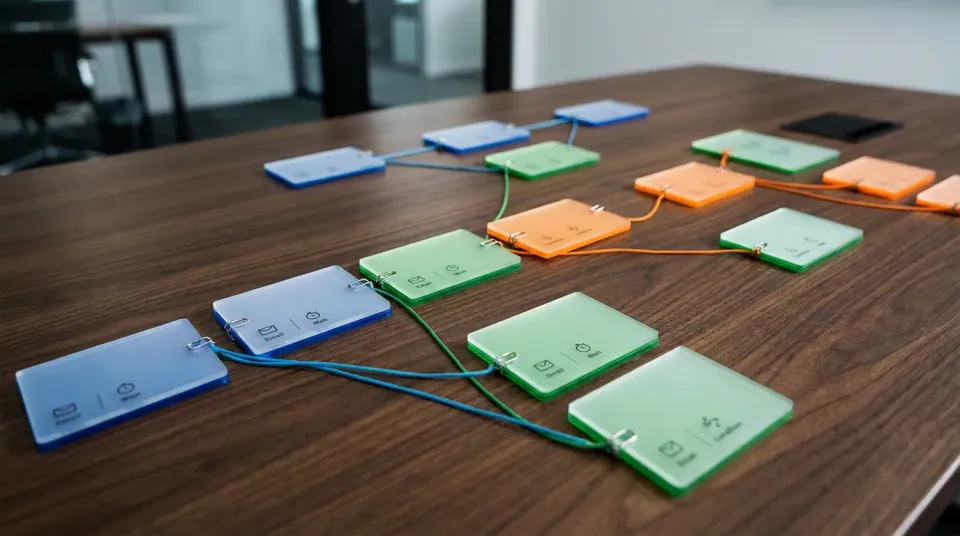
A proven lead nurture sequence balances educational depth, social proof, and tactical calls to action over a structured multi-email timeline. Below is the full annotated blueprint for a high-converting 6-stage automated sequence, complete with copy frameworks for every stage.
Stage 1: The Value Delivery & Expectation Setting Email (Day 0 — Immediate)
- Objective: Deliver the requested lead magnet instantly, confirm subscriber intent, and set clear expectations for future emails.
- Send Timing: Immediate (within 60 seconds of form submission).
- Subject Line Examples:
[Asset Inside] Your Email Deliverability Checklist + Next StepsHere is your guide + 1 quick question
> Stage 1 Annotated Copy Template: > > Subject: Your Email Deliverability Checklist is inside > > Preview Text: Access your guide now + what to expect over the next 10 days. > > Hi {{first_name|there}}, > > Here is your direct link to access The 2026 Email Deliverability Checklist: [Download PDF Guide Here] > > In this guide, you'll find the exact framework we used to clean over 10 million contact records and eliminate hard bounces for high-volume senders. > > What to expect next: > Over the next 10 days, I am going to share 3 specific case studies detailing how top growth teams prevent spam folder placement and protect sender scores. > > Quick favor: Reply to this email with "Received" so I know the guide landed safely in your primary inbox. > > Talk soon, > [Sender Name]
Stage 2: The Problem Amplification & Paradigm Shift Email (Day 2)
- Objective: Frame the prospect's core operational pain point, highlight the hidden costs of inaction, and challenge outdated industry assumptions.
- Send Timing: 48 hours after Email 1.
- Subject Line Examples:
Why 22% of your email list decays every year (and how to stop it)The hidden cost of unvalidated lead intake
> Stage 2 Annotated Copy Template: > > Subject: Why 22% of your email list decays every year > > Preview Text: Manual list cleaning is no longer enough to protect domain reputation. > > Hi {{first_name|there}}, > > Did you know that the average B2B email list degrades by roughly 22.5% every single year? > > Subscribers change jobs, abandon old inboxes, or type typos into signup forms. If you only clean your list once a quarter, hundreds of bad addresses accumulate between cleans. > > When you launch your next major campaign, those accumulated invalid addresses trigger hard bounce spikes. Gmail and Yahoo monitor bounce velocity closely—once your bounce rate crosses 2%, your primary inbox placement suffers across the board. > > The Paradigm Shift: > Industry leaders no longer rely on periodic manual cleaning. Instead, they validate email addresses in real time at the point of capture. > > Tomorrow, I'll share a case study showing how one team cut their hard bounce rate from 5.4% down to 0.1% using automated intake verification. > > Best, > [Sender Name]
Stage 3: The Social Proof & Case Study Breakdown Email (Day 4)
- Objective: Build undeniable credibility by showing how a peer organization solved the exact problem discussed in Stage 2.
- Send Timing: 48 hours after Email 2.
- Subject Line Examples:
How [Company X] reduced hard bounces by 94% in 30 daysCase study: From 68% inbox placement to 99.2%
> Stage 3 Annotated Copy Template: > > Subject: How GrowthScale reduced hard bounces by 94% > > Preview Text: From 5.4% bounce spikes to 99.2% inbox placement in under 30 days. > > Hi {{first_name|there}}, > > When GrowthScale scaled their ad campaigns last quarter, lead volume tripled overnight. > > But there was a hidden problem: 14% of the new form submissions contained invalid or disposable email addresses. > > Within three weeks, GrowthScale's sender score dropped from 98 to 72. Their marketing broadcasts started landing in the spam folder, burning thousands of dollars in ad spend. > > The Solution: > GrowthScale added real-time API verification to their signup forms and built a 4-step automated nurture sequence. > > The Results: > - Hard bounces dropped from 5.4% to 0.1% in 30 days. > - Open rates increased by 42% across automated sequences. > - Sales-qualified leads from email grew by 2.8x. > > [Read the Full GrowthScale Case Study Here] > > Best, > [Sender Name]
Stage 4: The Overcoming Objections & Feature-to-Benefit Mapping Email (Day 7)
- Objective: Address common buying hesitations (e.g., implementation time, pricing, team adoption) before the prospect voices them.
- Send Timing: 72 hours after Email 3.
- Subject Line Examples:
Does real-time verification slow down signup forms? (Benchmark test)3 misconceptions about setting up automated email workflows
> Stage 4 Annotated Copy Template: > > Subject: Does real-time verification slow down signup forms? > > Preview Text: We benchmarked 100,000 form submissions. Here are the latency numbers. > > Hi {{first_name|there}}, > > When marketing teams look at adding real-time email verification to their forms, they usually have one major hesitation: > > "Will adding an API verification call create form latency and reduce conversion rates?" > > We ran a benchmark across 100,000 live form submissions to test this exact question. > > The Findings: > - Average API response latency: 120 milliseconds (virtually imperceptible to users). > - Form completion rate impact: 0.0% change in submission speed. > - Data quality improvement: 100% elimination of syntax errors and dead domains. > > Furthermore, setting up the automated verification workflow takes under 5 minutes with our pre-built visual builder. > > [Watch 2-Minute Visual Setup Demo] > > Best, > [Sender Name]
Stage 5: The High-Intent Offer & Soft Urgency Call-to-Action Email (Day 10)
- Objective: Present a clear, direct offer with risk reversal to convert solution-aware leads into active users or pipeline opportunities.
- Send Timing: 72 hours after Email 4.
- Subject Line Examples:
Ready to clean your list automatically? Start with free validation creditsClaim your trial + customized deliverability audit
> Stage 5 Annotated Copy Template: > > Subject: Claim your trial + free validation credits > > Preview Text: Verify your first leads automatically with zero credit card required. > > Hi {{first_name|there}}, > > Over the past week, we've covered list decay, real-time verification gates, and automated sequence setup. > > If you're ready to protect your domain reputation and turn more leads into sales pipeline, I'd like to invite you to try Sendgrove. > > Here is what you get when you open a free account today: > - Free monthly validation credits to clean incoming lead intake. > - Access to our visual automation workflow builder. > - Built-in campaign analytics and real-time deliverability monitoring. > > No credit card required. Setup takes less than 3 minutes. > > [Start Your Free Account Today] > > Best, > [Sender Name]
Stage 6: The Fork-in-the-Road & Sunset/Routing Email (Day 14)
- Objective: Provide a clean decision point for leads who haven't converted, routing active readers to regular content and cold leads to a specialized re-engagement queue.
- Send Timing: 96 hours after Email 5.
- Subject Line Examples:
Should I keep sending you these deliverability guides?Fork in the road: Choose your email preferences
> Stage 6 Annotated Copy Template: > > Subject: Should I keep sending you these deliverability guides? > > Preview Text: Let me know if you want to stay on our educational list. > > Hi {{first_name|there}}, > > I noticed you haven't started your Sendgrove trial yet—and that is completely fine! > > I want to make sure I respect your inbox and only send emails that provide genuine value. > > Where should we go from here? > > 1. Option A: [Keep sending me weekly deliverability & automation guides] > 2. Option B: [Pause all marketing emails for now] > > If you're not ready for Sendgrove today, you can also check out our re-engagement campaign guide to learn how to keep your existing contact lists warm. > > Thanks for reading, > [Sender Name]
Behavioral Lead Scoring & Event Weighting Mechanics
To maximize the efficiency of lead nurture sequences, growth teams combine automated email workflows with behavioral lead scoring. Lead scoring assigns point values to subscriber actions, giving sales and marketing teams a clear numerical signal of prospect intent.
Behavioral Scoring Weight Table
| Subscriber Action / Signal | Category | Score Weight | Automated Workflow Action Triggered | | :--- | :--- | :--- | :--- | | Form Submitted (Top-Funnel Asset) | Inbound Intake | +10 Points | Enroll in 6-Stage Nurture Sequence | | Email Opened (Nurture Stage 1–3) | Content Engagement | +2 Points | Update last_engaged_date timestamp | | Email Link Clicked (Resource/Blog) | Deep Engagement | +5 Points | Add Tag engaged_reader | | High-Intent Link Clicked (Pricing Page) | Intent Signal | +15 Points | Accelerate sequence to High-Intent Track (Email 5) | | Case Study Page Viewed | Consideration Signal | +10 Points | Increment consideration_score field | | Documentation / API Docs Viewed | Technical Evaluation | +20 Points | Trigger sales notification webhook | | Demo Form / Free Account Started | Conversion Event | +50 Points | Goal Exit Rule triggered; exit nurture flow | | Email Bounced (Hard) | Negative Event | -100 Points | Immediately suppress and remove contact | | No Email Opens for 30 Consecutive Days | Inactivity Signal | -25 Points | Route to Re-Engagement Workflow |
Lead Lifecycle Score Tiers
Using the cumulative behavioral score, automation platforms automatically update contact lifecycle stages:
- Cold Lead (0–19 Points): Receives standard educational nurture content at 72-hour intervals.
- Warm Prospect (20–49 Points): Receives accelerated case studies and feature-benefit comparison emails.
- Sales-Ready Qualified Lead (50+ Points): Triggers immediate CRM assignment and sends high-intent trial or booking offers.
Step-by-Step Guide to Setting Up Automated Nurturing Workflows
Building an automated lead nurture sequence requires configuring intake rules, visual flow logic, exit conditions, and deliverability checks within your email automation software.
Visual Workflow Setup Protocol
- Step 1: Intake Gate: Run real-time API email verification to filter out disposable and invalid addresses before database insertion.
- Step 2: Segmentation Tags: Apply Source Tag (e.g.,
lead-magnet-pdf) and set initial Lead Score to +10. - Step 3: Visual Flow Logic: Configure trigger (
Tag Added), add Email 1 action, wait 2 days, evaluate engagement branch (if demo link clicked, taghigh-intentand accelerate offer; else send Email 2). - Step 4: Exit & Suppression: Set goal check (
Account CreatedorDemo Booked). When true, automatically exit contact from nurture flow and enroll into onboarding flow.
Step 1: Real-Time Lead Intake & Verification Gate
Before enrolling any new subscriber into an automated sequence, establish a verification gate at the API or form submission layer.
- Connect your lead capture form (e.g., custom HTML form, WordPress plugin, or landing page builder) to your email automation platform via webhooks or native integrations.
- Enable real-time syntax, MX record, and bounce-risk verification.
- Configure handling rules for catch-all or risky emails: allow valid addresses through immediately, while queueing questionable addresses for secondary double opt-in confirmation.
Step 2: Defining Segmentation Tags, Custom Fields, and Lead Source Triggers
To personalize nurture messaging at scale, establish standardized contact tags and custom fields during enrollment:
- Entry Trigger Tag:
trigger_lead_magnet_deliverability_guide - Lifecycle State Field:
lifecycle_stage = lead - Lead Score Field:
lead_score = 10 - Industry Field:
industry = ecommerce|industry = saas|industry = agency
Step 3: Mapping Visual Automation Logic
In your visual workflow editor, construct the sequence using triggers, actions, wait states, and decision branches:
- Trigger: Contact tagged
trigger_lead_magnet_deliverability_guide. - Action 1: Send Email 1 (Day 0 Value Asset).
- Wait: Pause execution for 2 days.
- Condition Filter: Has contact opened Email 1 OR clicked any link?
- Branch YES: Add +5 to Lead Score and send Email 2 (Problem Frame).
- Branch NO: Send Email 1.5 with an alternative subject line.
Step 4: Configuring Goal Tracking and Automatic Exit Suppression Rules
Exit rules ensure prospects stop receiving nurture emails the moment they achieve your primary campaign goal.
- Define the Goal Event: e.g., Tag added
account_created, Custom Field updatedplan_status = active, or Event triggereddemo_scheduled. - Enable Global Workflow Suppression: Set the workflow rule to "When goal is achieved, exit contact from this workflow immediately."
- Add a post-exit action: Enroll contact into
customer_onboarding_sequenceor notify sales team via webhook.
Step 5: Pre-Flight Testing, Deliverability Checks, and Inbox Placement
Never publish an automated nurture flow live without executing comprehensive pre-flight verification:
- Link & Merge Tag Audit: Send test emails to verify that dynamic tags (e.g.,
{{first_name}},{{company}}) render correctly without blank values. - Authentication Check: Ensure SPF, DKIM, and DMARC records pass verification for all sending subdomains used in the workflow.
- Seed List Testing: Send the full sequence to test inboxes across Gmail, Outlook, Yahoo, and iCloud to confirm primary inbox placement.
Technical Webhook & API Payload Mechanics
For engineering and marketing operations teams building custom integrations, automated nurture workflows interact with external systems via JSON webhooks.
1. Inbound Lead Enrollment Webhook Payload
When a web form or application backend registers a new lead, it fires an enrollment payload to your automation endpoint:
{
  "event": "lead.enrolled",
  "timestamp": "2026-07-27T10:15:30Z",
  "contact": {
    "email": "alex.growth@company.com",
    "first_name": "Alex",
    "last_name": "Rivers",
    "company_name": "Apex SaaS",
    "lead_source": "deliverability_checklist_landing_page"
  },
  "verification_gate": {
    "status": "valid",
    "risk_score": 0.02,
    "has_mx_records": true
  },
  "workflow_config": {
    "sequence_id": "seq_lead_nurture_v4",
    "initial_tag": "trigger_lead_magnet_deliverability_guide"
  }
}
2. Goal Exit Suppression Payload
When a lead converts (e.g., creates an account or books a call), your application sends a goal suppression payload to exit them from active sequences immediately:
{
  "event": "goal.achieved",
  "timestamp": "2026-07-28T14:22:10Z",
  "contact": {
    "email": "alex.growth@company.com",
    "account_id": "acc_884920"
  },
  "suppression_rule": {
    "action": "exit_and_suppress",
    "target_workflow_ids": ["seq_lead_nurture_v4"],
    "new_lifecycle_stage": "customer",
    "next_enrollment_workflow_id": "seq_customer_onboarding_v1"
  }
}
3 Specialized Nurture Sequence Playbooks for Different Business Models
Different business models require tailored email nurture messaging, cadence intervals, and call-to-action structures.
Playbook A: B2B SaaS Lead Nurturing (Free Trial to Paid Conversion)
- Target Audience: Software buyers, IT managers, and growth leads evaluating SaaS platforms.
- Sequence Cadence: Fast-paced 10-day sequence with high email density during the initial trial window.
- Key Content Angles: Time-to-value, API integration speed, security compliance, and user onboarding walkthroughs.
| Email Stage | Send Day | Core Focus & Angle | Primary Call to Action | | :--- | :--- | :--- | :--- | | Email 1 | Day 0 | Instant API Key delivery + 3-minute setup video | "Generate Your Free API Key" | | Email 2 | Day 1 | Quick-start guide: Installing validation snippet on web forms | "View Code Snippets & Documentation" | | Email 3 | Day 3 | Case Study: How SaaS company eliminated 98% of fake user accounts | "Read Full Case Study" | | Email 4 | Day 5 | Feature Focus: Real-time verification vs. bulk list cleaning | "Compare Validation Methods" | | Email 5 | Day 8 | Trial expiring alert + credit usage summary | "Upgrade to Growth Plan" | | Email 6 | Day 10 | Personal outreach from founder offering custom onboarding | "Schedule 15-Min Setup Call" |
Playbook B: B2B Professional Services & Agency Nurturing (High-Ticket Consulting)
- Target Audience: Enterprise VPs, CMOs, and Operations Directors seeking high-touch consulting or managed services.
- Sequence Cadence: Spaced 21-day cadence emphasizing deep domain authority, industry benchmarks, and strategic frameworks.
- Key Content Angles: Risk reduction, team capacity expansion, proprietary frameworks, and measurable ROI.
| Email Stage | Send Day | Core Focus & Angle | Primary Call to Action | | :--- | :--- | :--- | :--- | | Email 1 | Day 0 | Deliver Benchmark Report + Executive Summary | "Download Benchmark PDF" | | Email 2 | Day 3 | Breakdown of the #1 strategic mistake enterprise senders make | "Reply with your current setup" | | Email 3 | Day 7 | Deep-dive tear-down of a real-world deliverability crisis | "View Technical Audit Framework" | | Email 4 | Day 12 | Video walkthrough: Restructuring sender architecture | "Watch 7-Minute Strategy Breakdown" | | Email 5 | Day 16 | ROI Calculator: Quantifying revenue lost to spam placement | "Run Your Revenue Loss Numbers" | | Email 6 | Day 21 | Invitation for a complimentary 1-on-1 deliverability audit | "Book Executive Strategy Session" |
Playbook C: Ecommerce & High-AOV D2C Nurturing (Educating Before Purchase)
- Target Audience: Consumers considering premium products requiring education (e.g., luxury goods, specialized gear, health supplements).
- Sequence Cadence: 7-day visual-heavy sequence combining brand lifestyle imagery, customer reviews, and discount urgency.
- Key Content Angles: Material sourcing, craftsmanship, unboxing experiences, consumer reviews, and money-back guarantees.
| Email Stage | Send Day | Core Focus & Angle | Primary Call to Action | | :--- | :--- | :--- | :--- | | Email 1 | Day 0 | Welcome discount code + Brand Origin Story | "Shop Bestsellers with 15% Off" | | Email 2 | Day 2 | Product spotlight: Why our materials outlast competitors | "Explore Craftsmanship & Materials" | | Email 3 | Day 4 | User-generated content spotlight: Real customer results & photos | "See Customer Reviews" | | Email 4 | Day 6 | FAQ breakdown: Sizing, care instructions, and hassle-free returns | "Find Your Perfect Fit" | | Email 5 | Day 7 | Discount expiration reminder + Free shipping incentive | "Claim 15% Off Before Midnight" |
Technical Automation Mechanics & Decision Logic
Designing sophisticated automated lead nurturing workflows requires establishing clear rule matrices for triggers, wait states, decision nodes, and exception handling.

Trigger Events vs. Wait States vs. Goal Conditions
| Workflow Component | Node Type | Technical Definition | Example Execution | | :--- | :--- | :--- | :--- | | Enrollment Trigger | Entry Rule | The exact database event that enrolls a contact into the workflow | Event: Form_Submitted AND Form_ID == 1042 | | Static Delay | Wait State | Pauses workflow execution for a fixed duration | Wait: 48 Hours | | Dynamic Delay | Wait State | Pauses workflow execution until a specific calendar window or user event occurs | Wait until Day of Week == Tuesday AND Time == 09:00 AM EST | | Decision Branch | Logic Filter | Evaluates contact attributes or engagement history to split path | IF Contact Tag contains 'clicked_pricing' -> Branch A ELSE Branch B | | Goal Condition | Exit Rule | Monitors contact state continuously; exits workflow when criteria met | Exit IF Lifecycle_Stage == Customer | | Tagging Action | System Action | Modifies contact record attributes automatically | Add Tag: 'nurture_stage_3_completed' |
Dynamic Branching Matrix: Engagement-Based Pathing
Rather than treating all leads identically, visual automation engines evaluate real-time engagement to split leads into three distinct speed tracks:
- High-Engagement Track: Triggered when a lead clicks an email link and visits the pricing page. Action: Send Email 2B (Case Study & Demo Offer) at an accelerated 24-hour interval.
- Standard Engagement Track: Triggered when a lead opens emails but does not visit high-intent pages. Action: Send Email 2A (Problem Amplification) at the standard 48-hour interval.
- Low-Engagement Track: Triggered when a lead shows no opens or clicks in 48 hours. Action: Send Email 1B with an alternative subject line and pause execution for 4 days before retrying.
Handling Bounces, Soft Failures, and Unsubscribes
Your visual automation flow must handle negative events gracefully to preserve domain sender health:
- Hard Bounce Event: Immediately set contact status to
Bounced / Suppressed. Remove contact from all active workflows and update CRM status toUnreachable. - Soft Bounce (Consecutive 3x): Pause active workflow for 7 days. Queue contact for automated re-verification before attempting further workflow steps.
- Unsubscribe Event: Process globally within 1 second. Remove contact from all active and future marketing automation workflows instantly.
Troubleshooting & Node Triage for Underperforming Sequences
When an automated nurture sequence fails to hit target conversion rates, systematically audit performance node by node using this triage framework:
- Symptom 1: Low Email 1 Open Rate (<40%): Root cause is usually a weak subject line, bad deliverability, or delayed send time. Fix by auditing SPF/DKIM authentication and verifying immediate (<60s) webhook trigger execution.
- Symptom 2: High Unsubscribe Rate on Email 3 (>0.8%): Root cause is a premature sales push or irrelevant content. Fix by softening the pitch and replacing product features with a customer case study problem breakdown.
- Symptom 3: High Click-Through Rate but Zero Goal Conversions: Root cause is landing page friction or disconnect between email and landing page copy. Fix by aligning landing page headlines with the email offer and enabling 1-click account creation.
List Hygiene & Deliverability Safeguards for Automated Sequences
Because automated nurture sequences run continuously in the background, deliverability degradation can occur silently if list hygiene safeguards are not built into your workflows.
Real-Time API Validation on Lead Capture Forms
Preventing toxic data from reaching your automation database is the single most effective deliverability safeguard.
// Example: Real-time email validation script on form submit
async function validateLeadBeforeEnrollment(emailInput) {
  const apiKey = 'YOUR_SENDGROVE_API_KEY';
  const response = await fetch(`https://api.sendgrove.com/v1/verify?email=${encodeURIComponent(emailInput)}`, {
    headers: { 'Authorization': `Bearer ${apiKey}` }
  });

  const result = await response.json();

  if (result.status === 'valid') {
    // Proceed with form submission and automation enrollment
    submitForm();
  } else if (result.status === 'risky' || result.status === 'catch_all') {
    // Trigger double opt-in confirmation email before enrolling
    triggerDoubleOptIn();
  } else {
    // Reject submission and prompt user for valid address
    displayFormError('Please enter a valid business email address.');
  }
}
Automated Re-Verification Rules for Long-Nurture Workflows
For long-cycle B2B nurture flows spanning 30, 60, or 90 days, contacts can change jobs, abandon inboxes, or suffer email domain shifts mid-sequence.
- 30-Day Automated Check: Add a re-verification check node before sending major promotional offers in long-term nurture flows.
- Role-Based Email Filtering: Automatically identify addresses like
sales@,support@, orinfo@and route them to specialized low-priority workflow paths.
Managing Sender Reputation across Automated Trigger IP Pools
High-volume senders should segregate automated transactional and trigger emails from broad marketing broadcasts:
- Triggered Workflow IP Pool: Dedicate high-reputation IP addresses strictly to high-engagement event triggers (e.g., password resets, welcome emails, immediate lead magnet delivery).
- Nurture & Broadcast IP Pool: Route long-term marketing nurture sequences and newsletter broadcasts through secondary pool IP addresses to protect mission-critical transactional delivery.
Multi-Channel Nurture Coordination (SMS, In-App, & Webhooks)
Modern lead nurturing extends beyond the email inbox. By orchestrating multi-channel touchpoints within a unified automation builder, growth teams achieve higher response rates.
- Email + SMS Pairing: If a high-intent lead opens Email 5 (the trial offer) but does not click within 24 hours, fire an automated SMS nudge: "Hi Alex, saw you checked out the deliverability audit. Want me to save your free credits?"
- In-App Messaging Triggers: When an enrolled prospect logs into your free portal, display an in-app banner reinforcing the lesson from Email 3.
- Sales Slack Notifications: When a prospect reaches a lead score of 50+ points, fire an instant Slack alert to your account executive team with the lead's engagement history.
Optimizing & A/B Testing Your Lead Nurture Sequences
Automated sequences should never be treated as "set and forget" assets. Systematic optimization yields compounding improvements in conversion rates over time.
Subject Line & Preview Text Testing Frameworks
Test one variable at a time across high-volume workflow stages:
- Test A (Curiosity-Driven):
The #1 reason email automated sequences fail - Test B (Benefit-Driven):
How to double lead conversion with dynamic automation - Test C (Question Format):
Is your lead nurture sequence leaking revenue?
Delay Timing Optimization Matrix
A/B test delay intervals between sequence steps to identify your audience's optimal reading cadence:
| Test Cohort | Cadence Structure | Ideal Use Case | Observed Impact | | :--- | :--- | :--- | :--- | | Aggressive (Fast) | Day 0, Day 1, Day 2, Day 4, Day 6 | Free Trial SaaS & Time-Sensitive Offers | Higher initial conversion, slightly higher unsubscribe rate | | Balanced (Standard) | Day 0, Day 2, Day 4, Day 7, Day 10 | B2B Services, High-AOV Products, General Lead Magnets | Optimal balance of high engagement and low spam complaints | | Extended (Slow) | Day 0, Day 4, Day 8, Day 14, Day 21 | High-Ticket Enterprise Consulting & Complex Buying Committees | Lower short-term conversion, higher long-term brand retention |
Key Dashboard Metrics to Monitor
When reviewing performance metrics in your Sendgrove pricing and plans dashboard, monitor these key indicators:
- Node Completion Rate: The percentage of enrolled contacts who successfully reach the final email step without unsubscribing or bouncing.
- Step-by-Step Drop-Off Rate: Identifying specific emails where open or click rates decline sharply, signaling weak content or bad send timing.
- Pipeline Velocity: The average number of days it takes an enrolled lead to move from initial form submission to primary goal conversion.
- Unsubscribe Rate per Step: Ensuring no individual email exceeds a 0.5% unsubscribe threshold.
FAQ: Frequently Asked Questions About Lead Nurturing Email Sequences
What is an automated lead nurturing email sequence?
An automated lead nurturing email sequence is an event-driven series of pre-written emails sent automatically to prospects over time. Its goal is to educate leads, solve core pain points, and build trust until they are ready to convert into paying customers.
How many emails should be in a standard lead nurture sequence?
A standard B2B or SaaS lead nurture sequence typically consists of 5 to 7 emails delivered over a 10 to 14 day period. High-ticket enterprise services may extend to 8 to 10 emails over 30 days, while simple B2C lead magnets may achieve optimal conversion in 3 to 4 concise emails.
What is the ideal time delay between nurture emails?
For most lead nurture campaigns, an initial delay of 48 hours between Email 1 and Email 2 works best. Subsequent emails should be spaced 48 to 72 hours apart. Avoid sending marketing nurture emails on back-to-back calendar days unless delivering a time-sensitive free trial sequence.
How do I stop a lead from receiving nurture emails after they purchase?
Configure an automatic goal exit rule in your visual automation builder. Set the workflow condition to monitor for a conversion event (such as account_created, purchase_completed, or demo_booked). When the event fires, the system automatically removes the contact from the prospect nurture flow and enrolls them into an onboarding sequence.
What is a good open rate for an automated lead nurture sequence?
Automated lead nurture emails generally achieve significantly higher engagement than broad broadcast newsletters. Email 1 (the asset delivery) typically sees open rates between 50% and 70%. Subsequent emails in the sequence should maintain open rates of 30% to 45%, with click-through rates averaging 3% to 8%.
Should I send lead nurture emails from a personal name or a company name?
Data consistently shows that emails sent from a personal name combined with a company brand (e.g., Sarah from Sendgrove or Alex @ Sendgrove) achieve higher open rates and lower spam complaint rates than emails sent from generic company names or unmonitored noreply@ addresses.
How does email validation improve automated sequence conversion rates?
Real-time email validation filters out invalid, mistyped, and spam trap email addresses at the form intake step. By ensuring only deliverable inboxes enter your automated sequence, you maintain a high sender domain score, prevent bounce rate spikes, and ensure your emails reach the primary inbox of legitimate prospects.
Can I run multiple lead nurture sequences simultaneously?
Yes, but you must enforce workflow exclusivity rules. If a contact fills out two different lead magnet forms on your website, set global concurrency controls so they are enrolled in only one primary nurture sequence at a time. Multi-enrolling contacts causes email fatigue and spikes unsubscribes.
What should I do with leads who complete the entire nurture sequence without converting?
Leads who complete the sequence without converting or unsubscribing should be automatically tagged as nurture_completed_unconverted. Route these contacts into a lower-frequency long-term broadcast segment (e.g., receiving your bi-weekly educational newsletter) or enroll them into a cold prospect re-engagement campaign after 60 days.
What is the difference between lead scoring and lead nurturing?
Lead nurturing is the process of delivering educational content to move prospects down the funnel. Lead scoring is the measurement system that assigns points to prospect actions (opens, clicks, page visits) to determine when a nurtured lead has become qualified for sales outreach.
How do dynamic triggers differ from static time delays?
Static time delays wait a fixed number of days before sending the next email regardless of prospect behavior. Dynamic triggers evaluate real-time subscriber actions—such as clicking a pricing link or visiting a feature page—to immediately split the prospect onto an accelerated or specialized email path.
How do I prevent nurture emails from landing in the spam folder?
To maintain primary inbox placement, authenticate your domain with SPF, DKIM, and DMARC; validate email addresses at form intake to prevent hard bounces; maintain low spam complaint rates (<0.1%); and remove unengaged contacts who haven't opened emails in 60+ days.