Blog
B2B Email Marketing Strategy for SaaS: A Complete Guide
Learn how to build a powerful B2B email marketing strategy for your SaaS business. Our guide covers segmentation, lead nurturing, automation, and key metrics.

> TL;DR: A successful B2B email marketing strategy for SaaS involves more than just sending newsletters. It requires a deep understanding of the long B2B sales cycle, a focus on building relationships through value-driven content, and leveraging automation to nurture leads effectively. Key pillars include granular segmentation based on firmographics and user behavior, creating personalized email sequences for different stages of the buyer journey (from awareness to trial to post-purchase), and maintaining a high-quality list through diligent email validation.
B2B email marketing isn't about quick wins; it's about building a powerful, long-term engine for lead generation, nurturing, and customer retention. For SaaS companies, where the customer lifecycle is long and complex, a well-executed email strategy is the critical link between a potential lead and a loyal, high-LTV customer.
Unlike B2C marketing, which often targets individual emotions and impulse buys, B2B decisions involve multiple stakeholders, larger budgets, and a focus on ROI. Your email strategy must reflect this reality, delivering consistent value, building trust, and guiding prospects through a complex decision-making process. This guide provides a comprehensive framework for building a B2B email marketing strategy that drives sustainable growth for your SaaS business.
Understanding the B2B SaaS Buyer's Journey
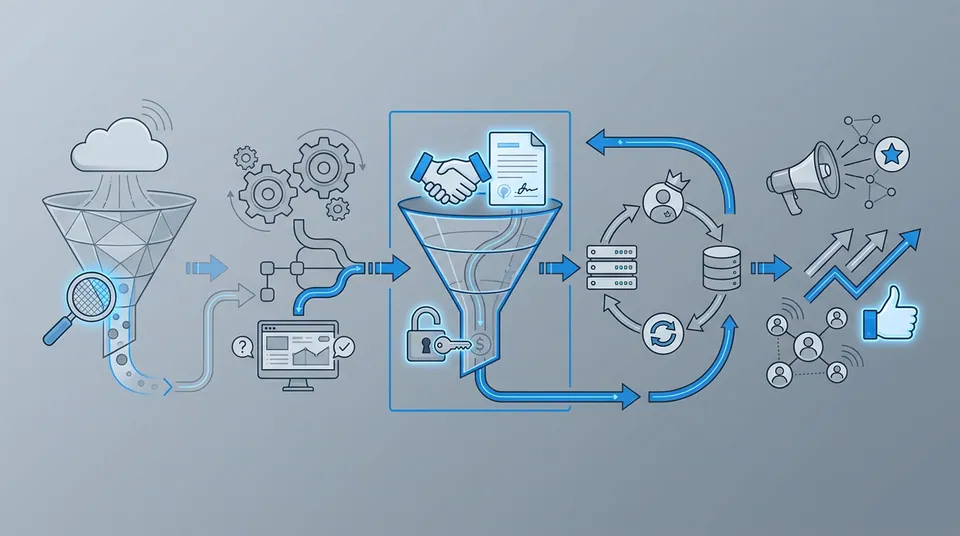
Before you can effectively market to B2B clients, you must understand how they buy. The B2B buyer's journey is rarely a straight line. It involves multiple touchpoints, extensive research, and a committee of decision-makers. Your email strategy must align with these stages:
- Awareness: The prospect is experiencing a problem and begins researching potential solutions. They are looking for educational content, not a sales pitch. Your emails at this stage should be informative and helpful, offering blog posts, whitepapers, or webinars that address their pain points.
- Consideration: The prospect has clearly defined their problem and is now evaluating different vendors and solutions. This is where you can introduce your product more directly. Case studies, comparison guides, and free trials are powerful assets. Your emails should showcase your value proposition and differentiate you from the competition.
- Decision: The prospect is ready to make a purchase. They are comparing pricing, features, and implementation details. Emails at this final stage should focus on building confidence and making it easy to buy. This includes pricing page links, testimonials, and booking links for a final demo or sales call.
- Retention & Advocacy: The journey doesn't end at the sale. For SaaS businesses, retention is paramount. Post-purchase emails should focus on user onboarding, feature adoption, and customer success. A strong onboarding sequence can dramatically reduce churn and turn new customers into loyal advocates for your brand.
Email is the only channel that can effectively nurture a lead through every single one of these stages with personalized, timely, and scalable communication.
Building a High-Quality B2B Email List

Your B2B email strategy is only as good as the list you're sending to. A high-quality list isn't just about size; it's about relevance, accuracy, and consent. Aggressively growing a list with unqualified leads will only lead to low engagement, high bounce rates, and a damaged sender reputation.
Inbound Lead Generation: The Foundation
The best leads are the ones who come to you. Focus on creating valuable content that attracts your ideal customer profile (ICP).
- Gated Content: Offer in-depth resources like ebooks, whitepapers, and research reports in exchange for a business email address.
- Webinars & Events: Host live or on-demand webinars that educate your audience on a specific topic. The registration list is a goldmine of engaged leads.
- Demo & Trial Sign-ups: Prospects who sign up for a product demo or free trial are high-intent leads. They should be a top priority for your nurturing sequences.
- Newsletter Subscription: A well-written, value-packed newsletter can be a powerful tool for staying top-of-mind with prospects who aren't ready to buy yet.
It's critical to distinguish between marketing to people who have explicitly opted in versus cold outreach. While both can have a place, permission-based marketing consistently yields higher engagement and ROI. For a deeper look, see our guide on cold outreach vs permission-based marketing.
The Importance of List Hygiene
B2B data decays quickly. People change jobs, companies get acquired, and email addresses are abandoned. Sending to stale email addresses leads to hard bounces, which severely damage your sender reputation.
This is where proactive email validation becomes non-negotiable. Integrating a tool that verifies emails at the point of capture is the most effective way to keep your list clean. Sendgrove’s platform includes built-in email validation to ensure new leads are valid before they even enter your marketing funnel, protecting your deliverability from day one.
Advanced B2B Segmentation Strategies for SaaS
In B2B, you're not marketing to a single person; you're marketing to a business with specific needs, goals, and internal structures. Generic, one-size-fits-all email blasts don't work. Granular segmentation is the key to delivering relevant messages that resonate with different members of the buying committee.
Here are several layers of segmentation you should be using:
1. Firmographic Segmentation
This is the B2B equivalent of demographic segmentation. It involves grouping accounts based on company-level data:
- Industry: A SaaS for healthcare will use different language and use cases than one for manufacturing.
- Company Size: A startup with 10 employees has different needs and buying power than a 10,000-person enterprise.
- Geography: Location can be crucial for targeting, especially for sales territories or region-specific compliance.
- Technology Stack: Knowing what other software a company uses (e.g., their CRM, helpdesk, or cloud provider) can be a powerful indicator of fit.
2. Behavioral Segmentation
This is where the real power lies. Behavioral segmentation groups users based on their actions (or inaction) with your product and marketing materials:
- Trial Engagement Level: Separate users who are actively using your trial from those who signed up but never logged in.
- Feature Adoption: Target users who have adopted key features with advanced tips, and users who haven't with educational content to increase engagement.
- Content Consumed: If a lead downloaded a whitepaper on a specific topic, nurture them with more content related to that interest.
- Pricing Page Visits: A prospect who has visited your pricing page multiple times is a high-intent lead and could be flagged for a sales touch.
3. Role-Based Segmentation
Within a target account, you have different players. The end-user, the IT manager, and the CFO all have different priorities. Tailor your messaging accordingly:
- End-Users: Focus on features, ease of use, and how your product makes their job easier.
- Managers/Decision-Makers: Highlight ROI, team productivity benefits, and strategic advantages.
- Financial/IT Stakeholders: Address topics like security, compliance, and total cost of ownership.
Effective segmentation relies on powerful tools. Sendgrove’s list segmentation tools allow you to combine these different data points to create highly specific audiences for your campaigns. For a deeper dive into tactics, read our complete guide to email list segmentation strategies.
Crafting Compelling B2B Email Content
Once you know who you're talking to, you need to figure out what to say. B2B email content must be professional, valuable, and directly address the recipient's business needs. Every email should pass the "so what?" test: why should this busy professional care?
Personalization Beyond the First Name
Hi {first_name} is a start, but true B2B personalization goes much deeper. Leverage the segmentation data you have to tailor the entire message:
- Reference their industry: "For a SaaS company like yours, reducing churn is priority #1."
- Acknowledge their role: "As a marketing manager, you're likely measured on lead quality..."
- Mention a recent behavior: "I saw you recently downloaded our guide to email automation..."
This level of personalization shows you've done your homework and aren't just sending a generic blast.
Focus on Value, Not Just Features
Don't just list what your product does; explain how it solves a problem and delivers a tangible business outcome. Instead of saying "Our product has Feature X," say "Feature X helps you cut down on manual data entry by 10 hours a week, freeing up your team for more strategic work."
| Instead of this (Feature-focused) | Try this (Value-focused) | |---|---| | We offer 24/7 customer support. | Get expert help anytime you need it so you never lose momentum on a critical project. | | Our platform has advanced analytics. | Make data-driven decisions with clear, actionable insights into your campaign performance and ROI. | | We have a powerful workflow builder. | Automate your lead nurturing and save your team hours of manual follow-up each week. |
Clear and Singular Call to Action (CTA)
Every email should have one primary goal. Don't confuse the reader by asking them to read a blog post, book a demo, and follow you on social media all in the same email. Make the desired next step crystal clear.
- Use action-oriented language: "Book Your Demo," "Read the Case Study," "Get the Whitepaper."
- Make it a button: A visually distinct button CTA almost always outperforms a simple text link.
Building these targeted campaigns is simple with a powerful platform. Sendgrove’s email marketing software provides the tools to build, personalize, and track the performance of your B2B email campaigns.
B2B Lead Nurturing & Automation Workflows
B2B sales cycles can be long, often spanning months. Manually tracking and following up with every lead is impossible at scale. This is where marketing automation becomes a B2B marketer's most valuable asset.
Automation allows you to deliver the right message to the right person at the right time, without manual intervention. Here are some essential automation workflows for any SaaS business:
1. Welcome Sequence for New Leads
When a prospect first subscribes to your newsletter or downloads a resource, they are at their peak engagement. A welcome sequence is your opportunity to make a great first impression and introduce them to your brand.
- Email 1 (Immediate): Deliver the resource they requested and introduce your company.
- Email 2 (2 days later): Share your most popular blog post or a relevant case study.
- Email 3 (4 days later): Introduce a soft CTA, like an invitation to a webinar or a link to your product page.
2. Trial Onboarding Sequence
For a SaaS business, the trial-to-paid conversion rate is a critical metric. A well-planned onboarding sequence can make or break this process. The goal is to guide the user to their "aha!" moment—the point where they experience the core value of your product.
- Focus on key activation events: Identify the 2-3 actions a user needs to take to become successful with your product.
- Trigger emails based on behavior: Send emails that celebrate progress ("Congrats on creating your first project!") or nudge inactive users ("Here's a quick guide to get you started."). Check out our guide on behavioral email triggers for more ideas.
3. Lead Nurturing for Cold or Stale Leads
Not every lead is ready to buy today. A long-term nurturing sequence keeps your brand top-of-mind by delivering value over time. Share valuable content, industry news, and product updates to build trust and credibility, so when they are ready to buy, you're the first vendor they think of.
Building these workflows is a core function of any modern email platform. Sendgrove’s automated email sequences make it easy to build these sophisticated B2B nurturing campaigns. For a step-by-step walkthrough, see our post on setting up an automated lead nurturing email sequence.
Measuring B2B Email Marketing Success & ROI
To justify your marketing spend and optimize your strategy, you need to track your performance. While standard email metrics are a good starting point, B2B marketing requires looking deeper to connect email activity to actual business results.
Key Metrics to Track
- Click-Through Rate (CTR): This is a primary indicator of whether your content is resonating with your audience. A low CTR might suggest a mismatch between your subject line and email body, or that the content isn't valuable to the segment.
- Conversion Rate: This is where the rubber meets the road. A conversion could be a demo request, a trial sign-up, or a content download. This metric directly measures the action you want users to take.
- Bounce Rate: Keep a close eye on your hard bounce rate. A rate consistently above 1-2% can damage your sender reputation. A high bounce rate is a clear sign of a stale or low-quality list.
- List Growth Rate: This shows how quickly you are attracting new leads to your funnel.
- Unsubscribe Rate: While some unsubscribes are normal, a high rate indicates that you are not providing enough value or are sending too frequently.
Connecting Email to Revenue
For B2B, the ultimate goal is to tie email marketing efforts directly to revenue. This often requires integration with your CRM.
- Marketing Qualified Leads (MQLs): How many leads generated from email campaigns are qualified enough to be handed over to the sales team?
- Sales Qualified Leads (SQLs): How many of those MQLs does the sales team accept and begin actively working?
- Customer Lifetime Value (CLV): How does the CLV of customers acquired through email compare to other channels? Email is often a driver of high-LTV customers due to the power of nurturing.
- Pipeline Influence: What percentage of the sales pipeline has been touched by an email marketing campaign?
Tracking these metrics is impossible without a robust analytics backend. Sendgrove’s analytics dashboard gives you a clear view into your campaign performance, allowing you to move beyond opens and clicks to understand your true marketing ROI.
Bringing It All Together: Your B2B Strategy Checklist
A successful B2B email marketing strategy is a living, breathing part of your growth engine. It requires a commitment to providing value, understanding your customer, and leveraging the right tools to scale your efforts.
Here’s a quick checklist to guide your strategy:
- [ ] Define your Ideal Customer Profile (ICP) and Buyer Personas. You can't target effectively if you don't know who you're talking to.
- [ ] Build your list with high-value inbound magnets. Focus on quality over quantity.
- [ ] Implement real-time email validation to protect your sender reputation.
- [ ] Segment your audience based on firmographics, behavior, and role.
- [ ] Create automated nurturing sequences for each stage of the buyer journey.
- [ ] Personalize your content to deliver value and build trust.
- [ ] Track metrics that connect email performance to business ROI.
By focusing on these core pillars, you can transform your email marketing from a simple broadcast channel into a powerful engine for predictable SaaS growth.
Ready to put these strategies into action? Explore Sendgrove’s suite of tools for B2B email marketing, automation, and validation.
Frequently Asked Questions (FAQ)
What is the main goal of B2B email marketing? The main goal is to build relationships and guide prospects through a long sales cycle. It focuses on lead generation, lead nurturing, and customer retention by providing value and building trust over time, ultimately driving revenue.
How often should I email my B2B list? It depends on the segment. For a new lead in a welcome sequence, every 2-3 days might be appropriate. For a long-term nurture list, once a week or bi-weekly with high-value content is often effective. Always monitor your engagement rates and adjust accordingly.
What are the most important metrics for B2B email marketing? Beyond open and click rates, focus on business-oriented metrics: conversion rate (e.g., demo requests), Marketing Qualified Leads (MQLs), pipeline influence, and the Customer Lifetime Value (CLV) of email-acquired customers.
What is the difference between B2B and B2C email marketing? B2C email marketing often targets individual consumers with emotional appeals and quick sales cycles. B2B marketing targets businesses, involves multiple decision-makers, has a much longer sales cycle, and focuses on logical arguments, ROI, and building long-term, trust-based relationships.
How can I personalize B2B emails? Go beyond the first name. Personalize based on their industry, company size, role in the company, or specific actions they've taken on your website (like downloading a specific ebook or visiting the pricing page).